1
Tell us the job
Share what you're storing, the volume and any food or UN requirements — right in the form.
Share what you're storing, the volume and any food or UN requirements — right in the form.
We pull tanks whose prior contents and condition fit your use, and quote by email within a day.
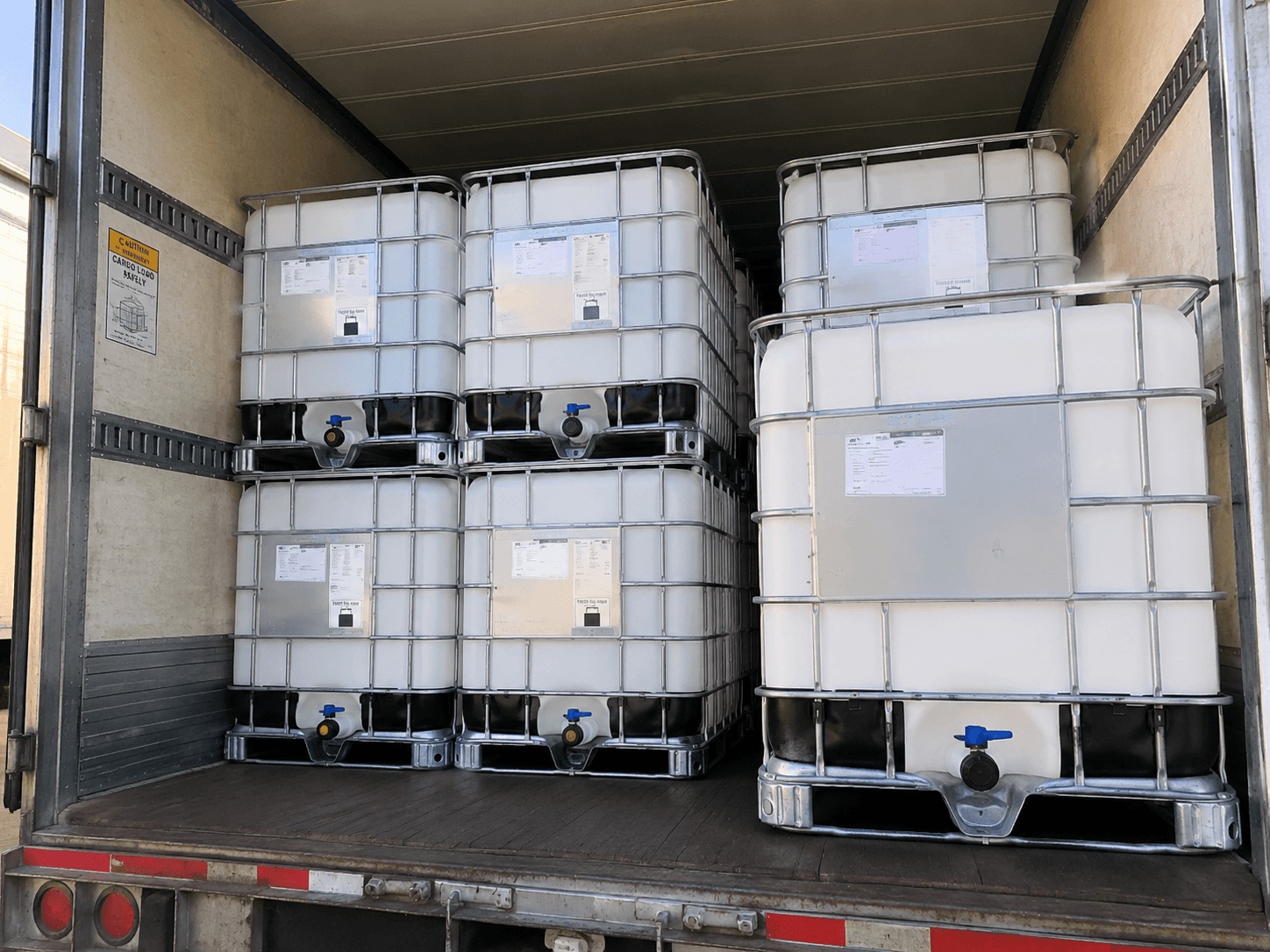
Local pickup in Peoria or freight anywhere in the Midwest — single totes to full truckloads.
Reuse isn't a vibe — it's a stack of avoided materials, emissions and dollars. Here's what our numbers actually look like.
standard IBC capacity
typical cost savings vs. new
steel reused per tote
HDPE plastic reused
CO₂e avoided per reuse cycle
per full truckload
typical quote turnaround
landfill goal
"Reconditioned" means something specific here — not a rinse and a prayer, but a documented, pressure-tested, grade-tagged process every single time.
Every incoming tote is tagged with its prior contents and quarantined by product family. No guessing, no cross-contamination risk.
Bottle, valve, cage and pallet are separated. Steel is inspected for bends, cracks and corrosion. Anything that fails is flagged before washing begins.
The bottle receives three high-pressure, high-temperature wash cycles with food-safe or industrial detergent matched to the prior product family.
If the existing bottle can't be brought to grade, a fresh HDPE bottle drops into the reclaimed cage — keeping the heaviest components in service.
Every assembly is pressure-tested to manufacturer spec and checked for seal integrity at the valve, cap and bottle seam.
Units receive a color-coded grade tag (Food, Industrial, Rinsed) plus a traceable wash record — audit-ready from day one.
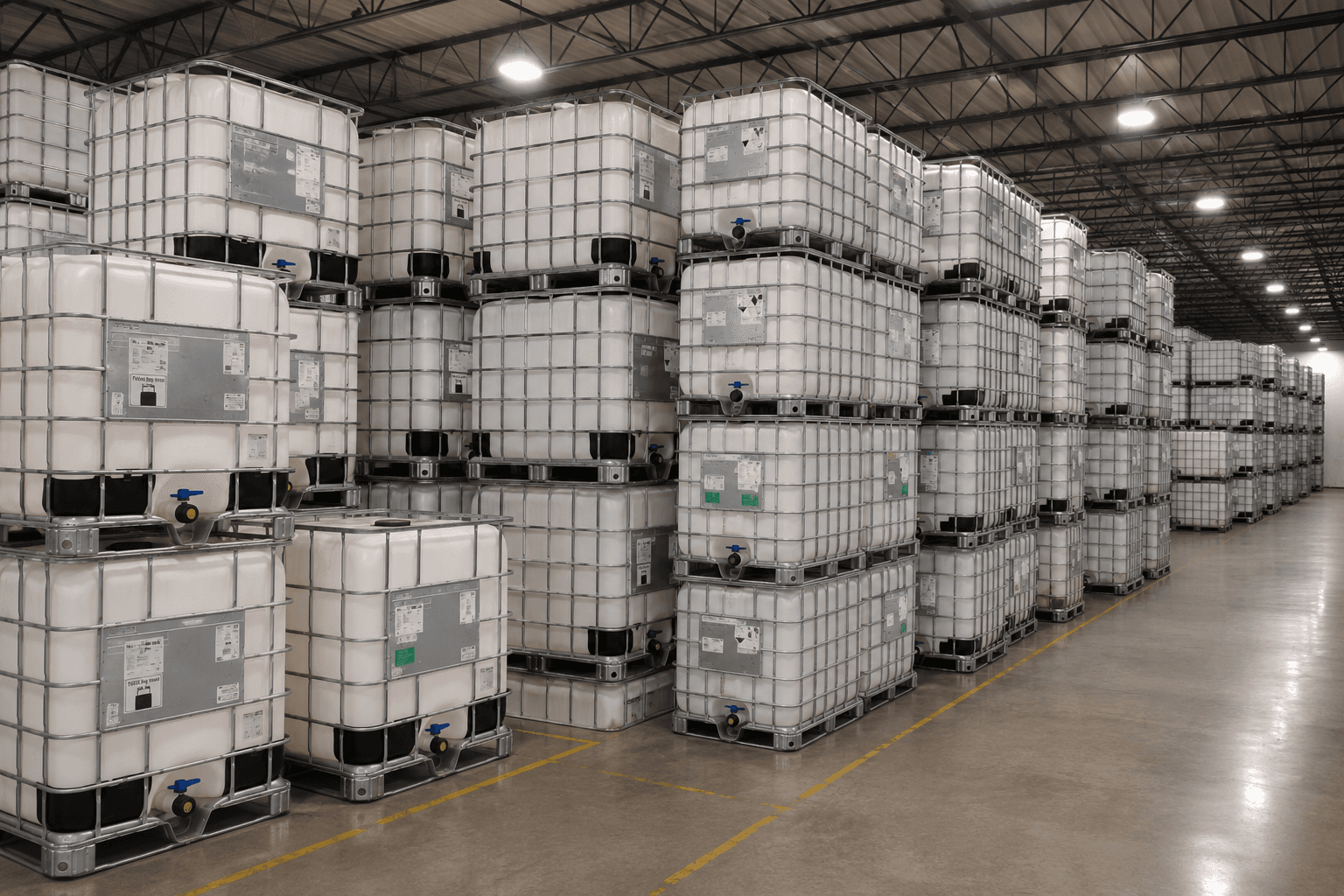
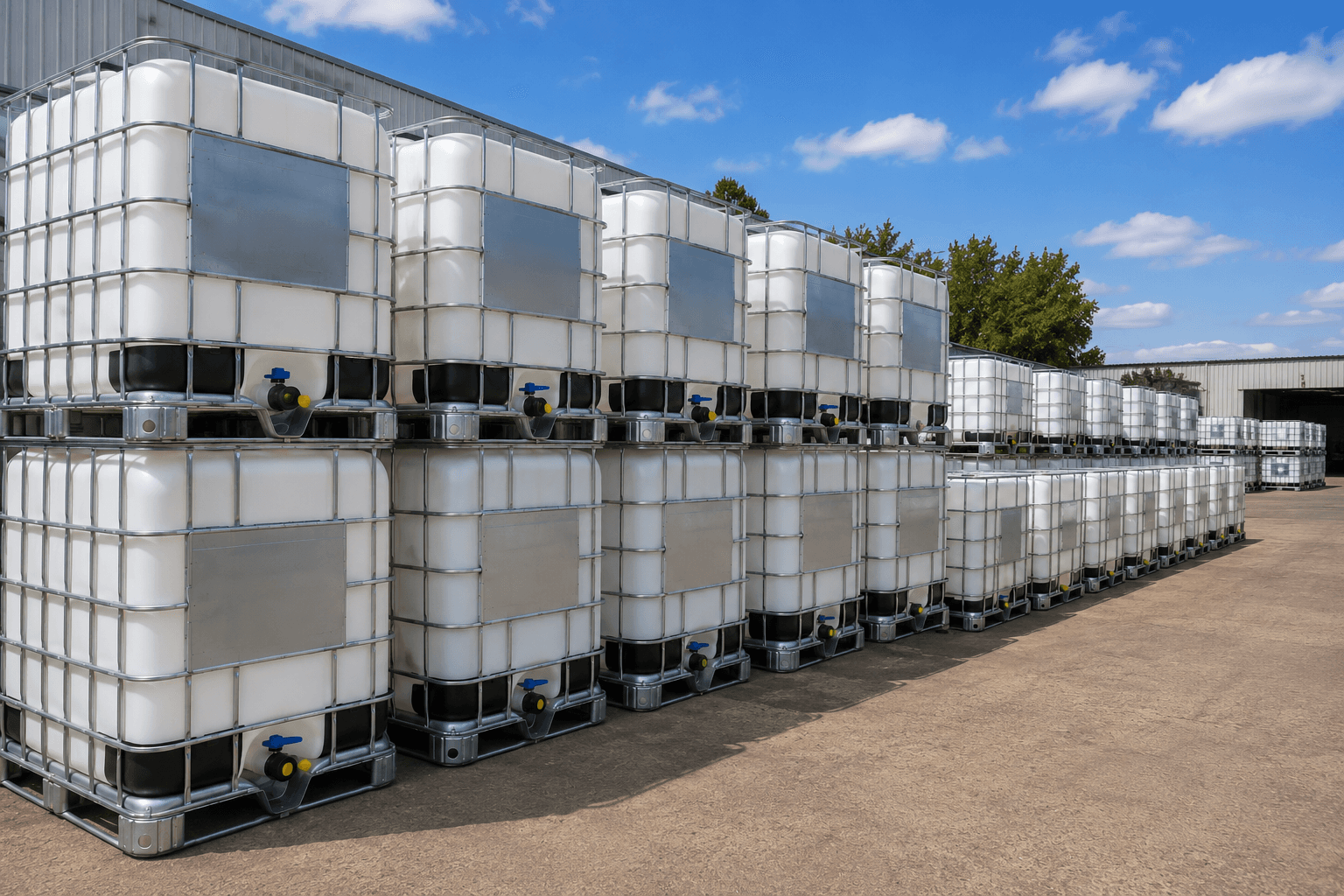
Reconditioned, food-grade and new tanks in stock and ready to ship.
Learn more →
Turn idle empties into cash and free up your yard.
Learn more →
Triple-wash, inspect, re-bottle and pressure-test — done right.
Learn more →
Pickup, delivery and reverse logistics across the Midwest.
Learn more →
Responsible end-of-life recovery of HDPE, steel and pallets.
Learn more →
Grade tells you the prior-contents family, wash protocol and documentation you get. It's the most important spec on the label.
| Grade | Prior contents | Wash protocol | Best for | Documentation |
|---|---|---|---|---|
| Food Grade | Food-safe only (syrups, oils, juices, vinegar) | Hot triple-wash + food-safe sanitizer | Brewing, beverage, edible oils, rainwater | Prior-contents log + wash record |
| Industrial | Non-food chemicals, detergents, lubricants | Hot triple-wash + industrial detergent | Chemical storage, ag chemicals, cleaning supply | Prior-contents log + wash record |
| Rinsed | Water, mild rinse products | Triple rinse | Non-potable water, irrigation, dust control | Intake log |
| New / Virgin | Never used | N/A | Pharma, ultra-pure, export, DEF | COA + UN cert (where applicable) |
We sell all three. Here's when each one makes sense, and what you're actually getting for your money and your carbon budget.
| Attribute | New / Virgin | Reconditioned ★ | Rebottled |
|---|---|---|---|
| Upfront cost | $$$$ | $$ | $$$ |
| Carbon footprint | High | Low | Medium |
| Virgin steel used | ~60 lbs | 0 lbs | 0 lbs |
| Virgin HDPE used | ~40 lbs | 0 lbs | ~40 lbs |
| Documentation | COA / UN cert | Prior-contents + wash log | Bottle COA |
| Best for | Pharma, export, DEF | Most industrial & food use | High-purity, repeat runs |
| Availability | Lead time may apply | In stock | In stock |
★ Our most popular option — and almost always the greenest one for the job.
Most suppliers do a single slice — they sell, or they wash, or they haul. We do the entire circle from our Peoria yard, which means fewer middlemen, honest grading with real prior-contents history, and a tank that never falls out of the loop.
Every reconditioned unit ships with a documented chain of custody — prior product, wash cycle, grade — not just a color sticker.
We buy, clean, repair, grade, sell, haul and recycle. No hand-offs to mystery third parties mid-loop.
We'll tell you if a rinsed tank safely does the job you need — even if that means a cheaper sale for us. It's the right call.
Our trucks pick up your empties on the same routes they deliver full ones, cutting your disposal cost and eliminating empty miles.
Every request is written, tracked and answered thoroughly — usually within one business day. No phone tag, no hold music.
Our Peoria yard means short hauls across Illinois, Iowa, Indiana and Wisconsin — not a 1,200-mile coast-to-coast freight bill.
A quick look at how different industries use our totes — and which grade fits which job.
Store and transport brewing water, liquid malt extract, or spent grain slurry.
Prior-contents log lets you pass your own food-safety audit.
Liquid fertilizer, herbicide, pesticide or irrigation water for row crops.
High-volume seasonal demand — we stock extra spring inventory.
Bulk storage of soap, degreaser, or disinfectant concentrate.
Chemical-resistant EPDM seals available on request.
Sodium hypochlorite, caustic soda, polymer dosing and lime slurry.
UN 31HA1/Y rated totes available for regulated chemical dosing.
Rainwater harvesting, gravity-fed irrigation, livestock water storage.
We also build ready-to-install rainwater kits with first-flush diverter.
Road brine, dust suppressant, pothole fill material, de-icing liquid.
Volume pricing for municipal purchasing orders.
Cleaned, pressure-tested tanks with a fresh bottle in the original cage.
First-use tanks for regulated, ultra-pure or export applications.
FDA-compliant tanks that only ever held food-safe products.
Valves, adapters, caps, lids, heaters and fittings to keep totes in service.
Rain harvesters, planters, compost systems and hydroponic rigs built from retired totes.
Empty IBCs cost you space, disposal headaches and missed revenue. We pick them up on existing delivery routes — so your empties become someone else's working tanks, and you get paperwork, cash or a credit depending on condition.
Sell your empties →Email us the number of empties, location and your preferred window. We batch pickups onto existing delivery routes so you're never paying for a dedicated empty run.
Tanks are loaded, transported and triaged at our Peoria yard: reusable, rebottleable or end-of-life recovery.
Disposal and recovery documentation lands in your inbox — ready for your ESG report or facility audit.
From family farms to food producers to municipal water crews, thousands of gallons move through our tanks every week across Illinois & the greater Midwest.
The right tank for the job isn't just about capacity — it's about certification, seal compatibility and documented prior contents. Here's what you need to know.
If you're transporting regulated hazardous materials, look for the UN 31HA1/Y mark. This indicates the tote has been type-tested and certified. Ask us — we stock UN-rated units.
Our food-grade units use natural HDPE bottles that meet FDA 21 CFR 177.1520. Every unit comes with a prior-contents log so you can verify suitability for your product.
Every reconditioned unit is pressure-tested to manufacturer spec before it leaves our yard. If it leaks, it doesn't ship.
Standard butterfly valves use a 2-inch opening with EPDM seals. For chemical resistance, Viton seals are available. Always match the seal material to your product.
Illinois agriculture, construction and food production drive sharply seasonal demand. Here's what to expect — and when to email us early.
Peak demand from agriculture — fertilizer, herbicide and water storage. Order early or email us in February to reserve your allotment.
Irrigation, dust control and construction water. Upcycled rainwater kits move fast. Lead times can stretch — plan ahead.
Harvest-related demand: liquid molasses, vinegar, juice concentrate. Food-grade reconditioned totes go fast post-harvest.
De-icing brine, road salt solutions and indoor heated storage. Band heaters and insulated jackets available. Lowest wait times for most grades.
Our Peoria yard is centrally located for efficient Midwest freight. Same-day local pickup is available for Peoria-area customers; most Midwest destinations receive orders within 1–3 business days via freight.
Intermediate Bulk Container — a 275 or 330-gallon liquid-storage tank with a steel cage, HDPE bottle, and pallet base.
A tote whose HDPE inner bottle has been replaced while the original steel cage and pallet are reused.
A used tote that has been washed, inspected, tested, and re-graded for safe reuse.
A UN certification mark indicating the tote is rated to transport regulated hazardous liquids.
A tote that has only ever held FDA-recognized food-safe products, documented and sanitized for reuse in food applications.
High-Density Polyethylene — the translucent plastic used for the inner bottle of most IBC totes.
The standard 6-inch screw thread on IBC tote lid openings; the most common cap and adapter interface.
Picking up empty totes on the return leg of a delivery run — eliminating deadhead miles and reducing per-unit freight cost.
Indirect supply-chain greenhouse-gas emissions. Packaging (including IBC totes) falls here; reconditioned tanks reduce this measurably.
The structural base of an IBC tote, usually wood or plastic-composite, rated to support the full liquid load.
CO₂e avoided
Steel reused
Virgin plastic avoided
Process water saved
That’s roughly the yearly CO₂ absorption of 44 trees. Estimates are conservative per-tote averages for guidance, not a certified audit — ask us for documented figures for your fleet.
Manufacturing a new tote means smelting fresh steel and molding virgin plastic. Reconditioning skips almost all of it. That's why reuse always beats recycling in our book — and why we'll steer you to a reused tank whenever it's safe to.
Read our approach →Reuse
Recondition
Recover
Landfill
One quick form — buy, sell, recondition, ship or recycle. No phone tag, just a thorough answer by email within a business day.
hello@ibcsolutionsillinois.com
Get a same-week quote to buy, sell, recondition, ship or recycle IBC totes across the Midwest.