Local Pickup — Peoria, IL
Pick up from our yard — email ahead to schedule loading. Bring your own truck, straps and blocks. We help load with the forklift.
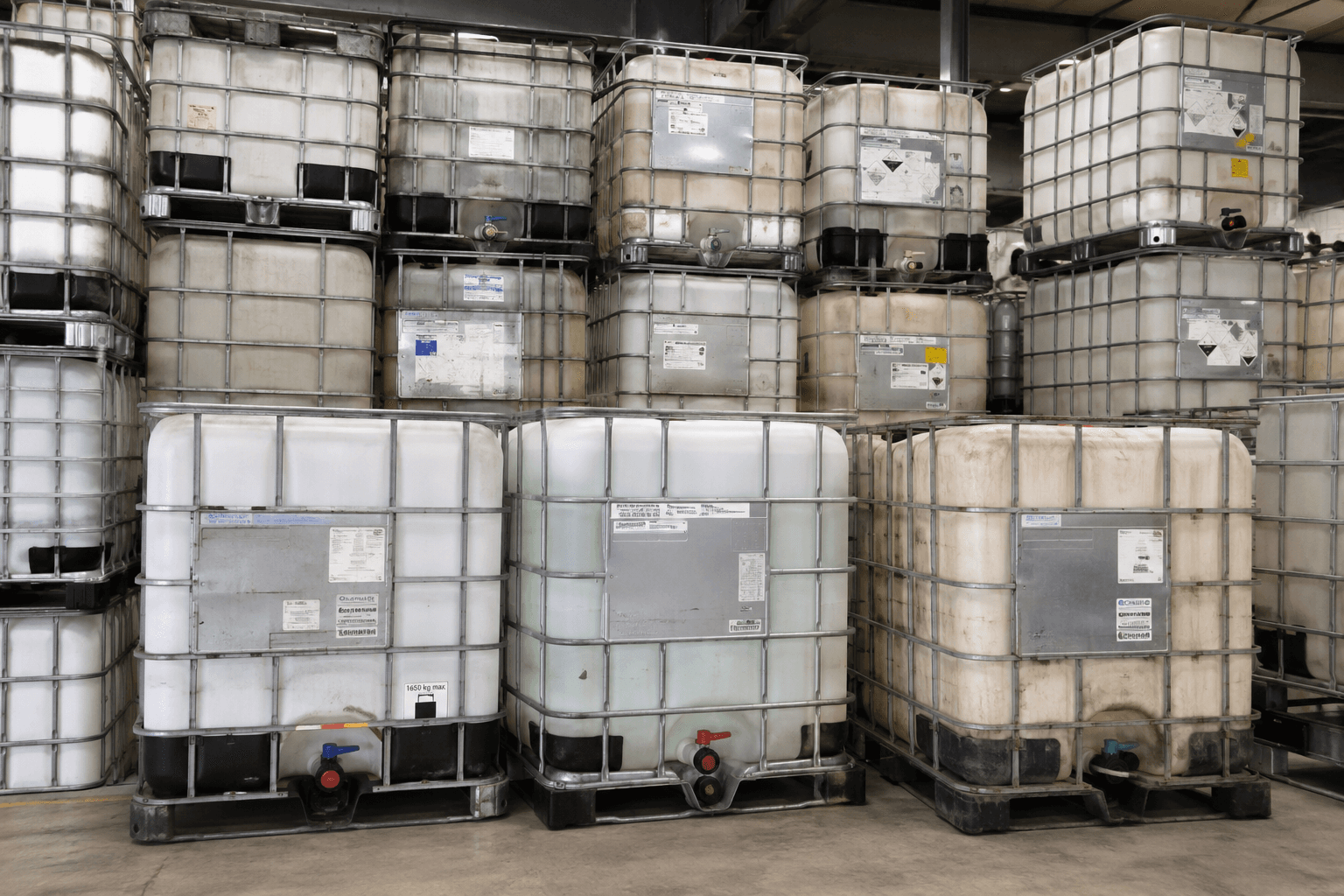
Cleaned, pressure-tested tanks with a fresh bottle in the original cage.
A reconditioned IBC tote is a used tank that has been triple-washed, inspected, pressure-tested and fitted with a food-safe or industrial bottle inside a reclaimed steel cage. It performs like new at roughly half the cost and a fraction of the carbon footprint.
Eco note: Choosing a reconditioned tote over new keeps ~90 lbs of steel and plastic in service and avoids the emissions of manufacturing a virgin cage from ore.
Reconditioned IBC totes are the workhorse of our yard and the smartest first choice for the vast majority of liquid-handling jobs. Every unit begins life carrying a single product, comes back to us, and is logged, inspected, washed or rebottled, pressure-tested and graded before it ships again. You get the same 275 or 330 gallons of usable capacity as a brand-new tank at roughly half the delivered price — and a fraction of the embodied carbon.
The reason the economics work so well is structural: the steel cage and the pallet, which are the heaviest and most energy-intensive parts of any tote to manufacture, stay in service indefinitely. We only replace what has to be replaced. That is the whole philosophy of reconditioning — renew the short-lived part, preserve the long-lived one, and keep the object out of the landfill for as long as it can safely serve.
| Capacity | 275 & 330 gallons |
|---|---|
| Cage & pallet | Reclaimed galvanized steel cage on a composite or steel pallet |
| Volume | 275 gal (1,040 L) / 330 gal (1,250 L) |
| Footprint | 40 in × 48 in pallet base |
| Valve | 2 in butterfly, S60x6 or NPT camlock |
| Lid | 6 in vented or solid screw cap |
| Wall | Blow-molded HDPE, translucent |
| Available grades | Food Grade, Industrial, Rinsed |
Every reconditioned tote starts life carrying a single product. When it reaches us we log its prior contents, strip the old bottle if needed, and run the cage and pallet through a full inspection. A new or deep-cleaned bottle drops into the reclaimed cage, we pressure-test the assembly, and it ships with a traceable grade tag.
A new IBC tote requires roughly 40 lbs of virgin HDPE and 60+ lbs of new steel. Reconditioning reuses the steel cage and pallet indefinitely and only replaces the bottle when contamination demands it. You get identical usable capacity while diverting the heaviest, most carbon-intensive components from landfill.
| Outlet thread | 2 in S60x6 coarse buttress — the universal IBC standard |
|---|---|
| Butterfly valve | Standard on most reconditioned tanks; 1/4-turn open/close |
| Ball valve | Higher-cycle alternative; stainless or polypropylene body |
| Camlock (Type C/E) | S60x6 → camlock for fast-connect filling and dispensing |
| Garden hose | S60x6 → 3/4 in GHT, male or female, for gravity dispensing |
| NPT | S60x6 → 1 in or 2 in NPT for pump suction and fixed-pipe connections |
| Seal — EPDM | For water, food products and mild chemistry; food-grade default |
| Seal — Viton | For solvents, fuels and aggressive acids; specify at order |
| 6 in vented cap | Allows gravity drain without vacuum lock — the go-to for open dispensing |
|---|---|
| 6 in solid cap | For pressurized, transported or sealed-fermentation applications |
| Tamper-evident | Security strip required for regulated or export cargo |
| Breather vent | For tall-neck or closed-loop setups where pressure equalization matters |
Need a different adapter or specialty valve? Browse all accessories →
| Standard outlet | 2 in butterfly valve, S60x6 thread |
|---|---|
| Ball valve upgrade | 2 in stainless ball valve for higher-cycle use |
| Camlock | Type C or E camlock adapter on the S60x6 outlet |
| NPT | 1 in or 2 in NPT adapter available |
| Seal – EPDM | Standard for water, soaps and mild chemistry |
| Seal – Viton | For solvents, fuels and aggressive acids |
| Lid | 6 in vented or solid cap; tamper-evident on request |
Pick up from our yard — email ahead to schedule loading. Bring your own truck, straps and blocks. We help load with the forklift.
We palletize and band for standard 96/102-inch LTL trailers across Illinois and the Midwest. Standard lead time 3–5 business days. We prepare the BOL.
40 totes fit a standard 48-ft dry van in two rows of 20. Our best per-unit rate. We schedule to your dock on your timeline.
Store detergents, soaps, non-potable water, coolants and compatible chemicals by the hundreds of gallons with a clear view of the level through the translucent bottle.
Feed wash bays, dust suppression, irrigation buffers and equipment cooling from a single tank with a gravity valve or pump connection.
Hold and dispense liquid fertilizer and compatible crop inputs; dedicate one tank per product to avoid cross-contamination.
Buffer liquids between process steps, decant from bulk deliveries, or stage product for shipment in a stackable, forkliftable container.
| 31 | IBC container type per UN standards |
|---|---|
| H | Plastic (HDPE) inner receptacle |
| A | Rigid outer body (steel cage) |
| 1 | Free-standing (no outer packaging needed) |
| Y | Packing group II — medium-danger liquids |
| 275L | Maximum gross mass or capacity in liters |
Just ask in your order email — no extra cost for documentation.
We record the tank's prior contents and quarantine it by grade so its history is never lost.
A hot-water triple-wash restores compatible bottles; when contamination demands it, a fresh bottle drops into the reclaimed cage.
We check the bottle for cracks and crazing, the cage for corrosion and bent tube, and the pallet for sound forklift entry.
Every assembled unit is leak- and pressure-tested, then tagged with a traceable grade before it leaves the yard.
Use it. Return it. Repeat it.
Every empty you send back to us is a cage and pallet that stays in service, a bottle that gets a new life, and a step that keeps material out of the landfill. The loop only closes if everyone closes it.
Get a same-week quote to buy, sell, recondition, ship or recycle IBC totes across the Midwest.